
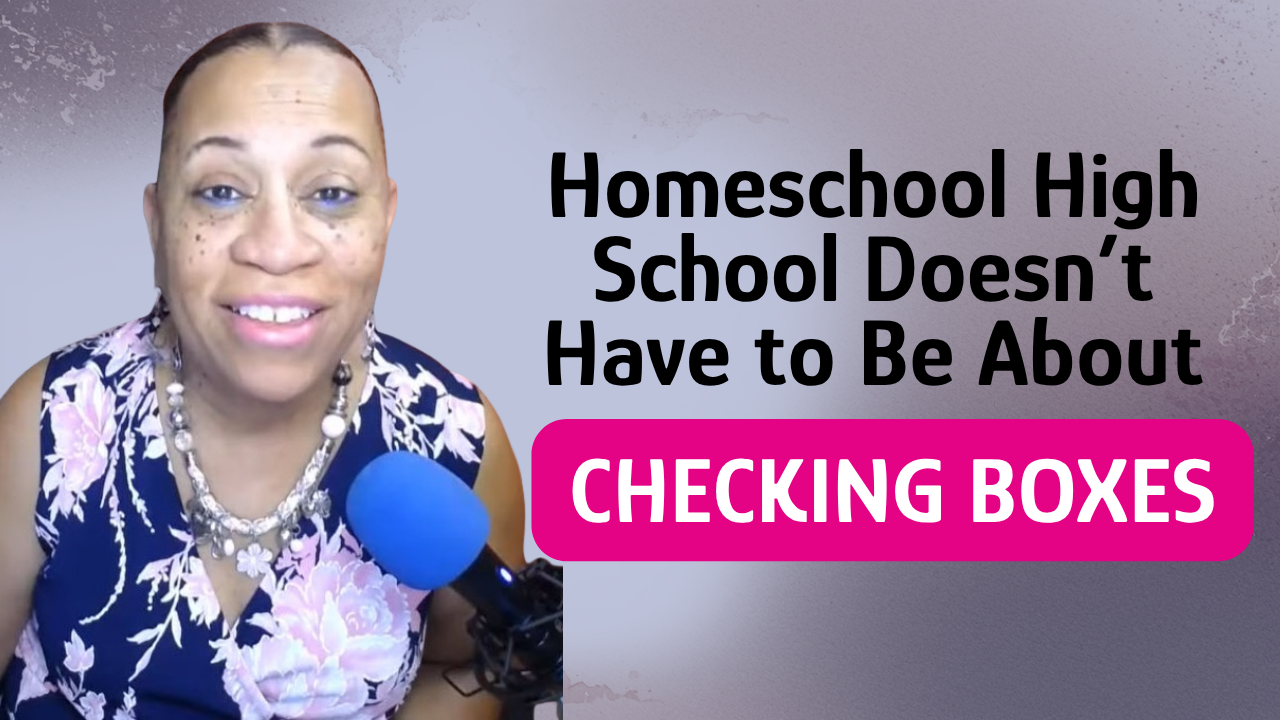
Homeschool high school can start to feel like one giant checklist.
English? Check.
Math? Check.
Science? Check.
History? Check.
Foreign language? Check.
Those subjects matter, of course. But what if we stopped looking at high school only as a list of boxes to complete and started asking a different question?
What actually fits this student?
After 23 years of homeschooling 5 children, one thing I became passionate about was creating a high school education that prepared each student for what came next while also making room for their interests, strengths, and growing independence.
That’s one of the beautiful freedoms of homeschooling high school. We can build something strong without making it cookie cutter.
Invite Your Teen Into the High School Planning Process
One of the first things I encourage parents to do is invite their high schooler into the conversation.
- Ask what they’re interested in.
- Ask what they’d like to learn.
- Ask what they might want to explore.
And don’t be surprised if the first answer is something like, “I don’t know. Just sign me up for whatever.” That response doesn’t mean the conversation isn’t worth having. Your teen may simply not be accustomed to thinking about educational choices yet.
Be patient.
When we invite teenagers into the planning process, we’re doing more than choosing classes. We’re helping them practice a skill they’ll need later.
They’ll eventually have to choose college courses, training opportunities, career paths, work opportunities, and many other things without us making every decision for them. High school gives us a wonderful opportunity to start modeling that process now.
At the same time, remember that you’re still the parent and the homeschool guidance counselor. Your student doesn’t have to figure this out alone.
Focus on Fit, Not Just What Everyone Else Is Doing
There’s nothing wrong with taking a traditional high school course sequence. If it fits your student, wonderful. But traditional doesn’t have to mean required in every situation.
One of the greatest advantages of homeschooling high school is the flexibility to look at your student and ask:
- What interests them?
- What skills do they need?
- What subjects would challenge them in a healthy way?
- What might help them discover a future direction?
- What could prepare them for college, career, military service, entrepreneurship, or another postsecondary path?
- What learning experiences might help them become a more thoughtful, capable young adult?
Fit matters. Your homeschool can be flexible and still be strong.
Unique High School Courses Can Be Valuable
High school is a preparatory season. Our teens are moving toward something. That “something” will look different from student to student, which is exactly why high school courses don’t all have to look identical.
A unique course can help a student explore an interest they’ve never had an opportunity to study before. It can help them develop skills such as:
- Critical thinking
- Research
- Communication
- Writing
- Collaboration
- Leadership
- Problem-solving
- Cultural awareness
- Decision-making
Those skills go far beyond a single high school class. They can also give students meaningful experiences to discuss later in applications, interviews, essays, and other opportunities.
Unique Courses Can Add Intentionality to the Transcript
Parents sometimes worry that a homeschool transcript has to look exactly like everyone else’s.
It doesn’t.
A transcript should accurately represent the student’s high school education, but that education can include thoughtful, meaningful courses that reflect the student’s interests and goals. Unique courses can show intentionality. They tell part of the story of what a student chose to study and explore.
Imagine a student who takes a global affairs simulation course because she’s fascinated by current events and international relations. Or a student who studies American literature through African American, Hispanic American, Native American, and Asian American voices. Those aren’t simply boxes on a transcript. They’re opportunities to explore ideas, develop skills, and discover interests.
Of course, transcript requirements, graduation expectations, college admission requirements, NCAA requirements, and other policies can vary. Be sure to confirm current requirements with the appropriate official organization when planning your student’s courses.
What Model Diplomacy Can Teach a High School Student
This fall, I’m teaching a Model Diplomacy and Global Affairs course. It’s a nonpartisan, discussion-based course designed to help students understand foundational concepts related to global affairs and decision-making.
Students will learn concepts such as sovereignty and foreign policy before stepping into simulations where they take on the roles of real-world decision-makers. Depending on the scenario, they may represent organizations or leadership roles connected with international decision-making.
Students will:
- Research an issue
- Consider multiple perspectives
- Discuss possible responses
- Negotiate with classmates
- Defend their recommendations
- Practice communicating clearly
That’s a lot more than memorizing information for a test. Students are practicing critical thinking, research, communication, and global awareness.
The fall Model Diplomacy course is designed as a half-credit high school course. Mature 8th graders with a strong interest in the topic may also be considered.
Learn more about my live online Model Diplomacy course
A Different Approach to American Literature
I’m also teaching Cross-Cultural American Literature, a full-year high school course. American literature is often taught through a familiar list of authors and texts. Those works certainly have value. But American literature is also much broader.
In this course, students will explore literature from Hispanic American, Native American, African American, and Asian American voices.
We’ll examine themes including:
- History
- Culture
- Identity
- Family
- Community
- The American experience
My goal isn’t simply for students to finish another English credit. I want them to encounter stories and perspectives that broaden the way they understand literature and the world around them.
Learn more about my live online Cross-Cultural American Literature course
You Have Permission to Think Differently About High School
Let’s face it, homeschooling is a huge commitment. When we reach the high school years, the pressure can feel even greater.
- Credits matter.
- Transcripts matter.
- Graduation planning matters.
- Preparing for what comes next matters.
But none of that means your student’s education has to become a four-year exercise in checking boxes.
- We can meet important academic goals while also creating room for curiosity, exploration, discussion, and meaningful learning.
- We can invite our teens into the process.
- We can pay attention to fit.
- We can choose courses intentionally.
And we can remember that high school is not simply something our students need to “get through.” It’s preparation for where they’re going next.
If choosing high school courses feels overwhelming, start with one question: What fits my student?
Then take the next right step.
If you’d like help thinking through your teen’s high school course choices, check out my free How to Decide on Homeschool High School Classes Workshop
You can do it.
Watch my video below for more on homeschooling high school and checking boxes:

I’m a homeschool mom of five—four college graduates and one college freshman—with over 23 years of homeschooling experience. Through Homeschool Natalie Mack LLC, I help parents navigate the homeschool journey with confidence, especially through the high school years, college prep, and NCAA eligibility.
I’m also the founder and Executive Director of the Military Homeschoolers Association (MHA), where I advocate for military homeschool families around the world. As a TEDx speaker, former therapist, and national homeschool leader, I’m passionate about helping families see that homeschooling isn’t just about academics—it’s about building legacy, purpose, and lifelong learners.